Loading content…
A guide to sustainable uniforms: recycled and organic materials, local production, fit that reduces returns, and real recycling programmes.
Over the last five years, every company ordering uniforms has heard the same question from employees, clients or investors: "Where do the materials come from?"
The question is new. Its impact on the professional uniform industry hadn't really existed until now. But once it started, it won't stop.
The traditional rationale for ordering a corporate uniform was straightforward: which fabric is more hard-wearing? Which design suits the brand? Which supplier has the best price?
Today, the following questions are added:
These are not decorative questions. For publicly listed companies or those with ESG reporting, they are part of their transparency obligations. For everyone else, they are the first signals of a market cleaning itself up.
Produced from recycled PET bottles, it offers the same technical performance as virgin polyester, with 59% less energy consumption in production. It is the most widespread sustainable option in 2026.
Grown without synthetic pesticides or chemical fertilisers. It uses 91% less water for irrigation than conventional cotton. The texture and softness are recognisable immediately.
Fibres that need almost no water and no pesticides. Hard-wearing, breathable, naturally recyclable. Progressively adopted in HoReCa uniforms and premium corporate design.
A fibre made from wood pulp, produced in a closed-loop system with 99.5% solvent recovery. Silky, absorbent, biodegradable. Ideal for medical and hotel uniforms.
For uniforms that need stretch, the new formulations use elastane recycled from production offcuts. The performance difference is invisible; the footprint difference is measurable.
Materials are only one part. A sustainable uniform programme also includes:
A uniform produced 200 km from the buyer has a transport footprint that's 1/40 of one shipped in from Asia. For European companies, regional production is the simplest lever for reducing the total footprint.
Uniforms that don't fit become returns. Returns mean extra transport, extra storage and, often, waste. 3D scanning brings the return rate below 5% — compared with 20–30% with the traditional method.
A uniform that lasts 24 months instead of 12 is automatically twice as sustainable. Durability specifications are part of the green strategy.
Worn pieces can be collected, processed and turned into new fibres or auxiliary products (insulation, padding, technical textiles). It isn't utopia — it's already standard at major European companies.
The main myth: sustainable uniforms cost more. That's true on the first order. It becomes false when you look at the full picture.
But:
Over 3 years, the equation flips.
A 2025 European study shows that 71% of employees under 35 consider the sustainability of the equipment they receive from their company to be important. For Gen Z, this figure exceeds 85%.
It's not a political demand. It's a cultural expectation. Companies that ignore the trend will pay by losing talent.
A sustainable supplier responds with documents. One that dodges the questions has already answered.
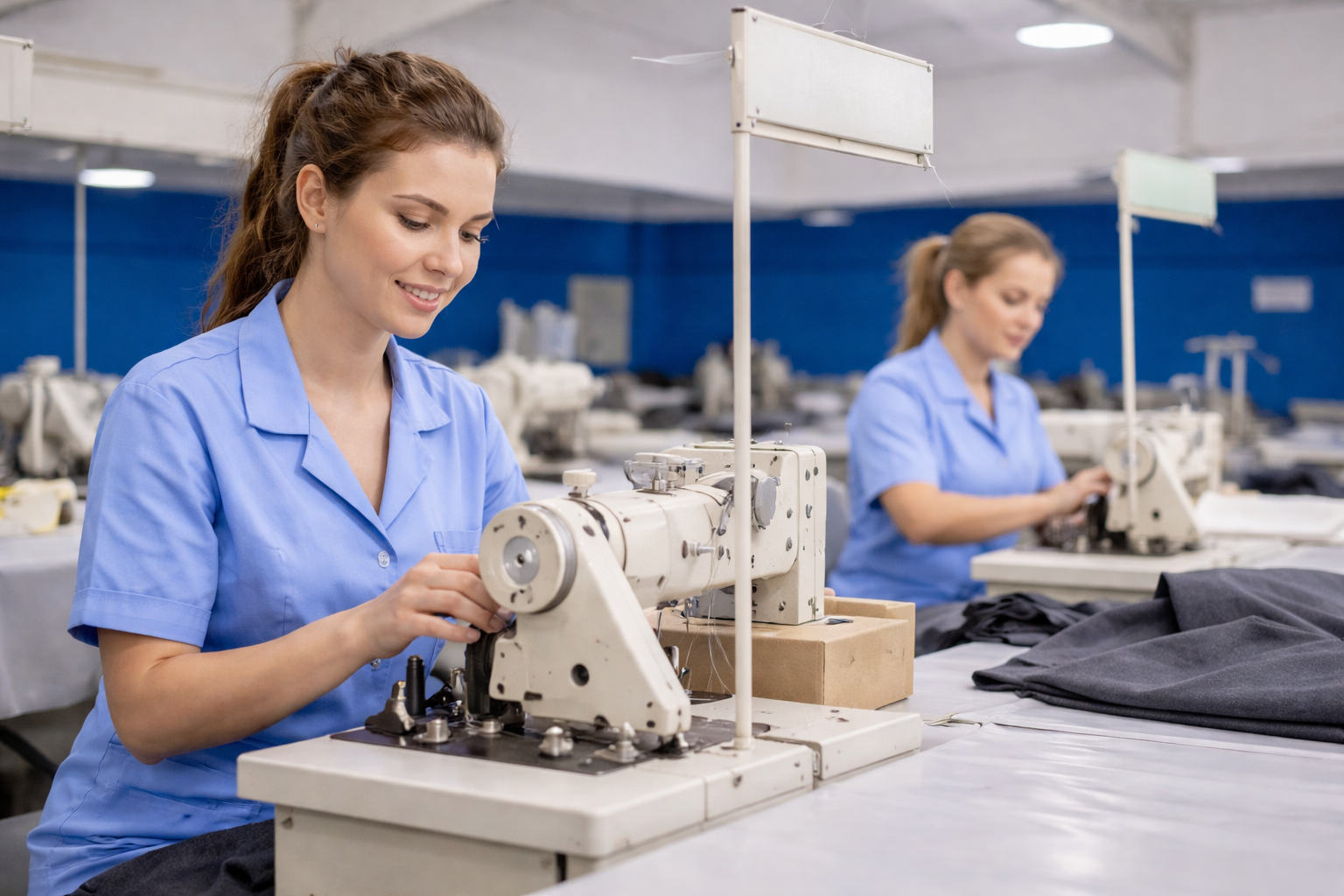
We produce in our own factory in Romania, with certified materials and a documented production process. A reduced footprint through local production, 3D scanning to cut returns, partnerships with recycled-polyester and organic-cotton suppliers, and a recycling programme for worn pieces.
Let's discuss a sustainable programme for your team — we start with an audit of your current needs.
Get in touch for a free consultation and a tailored quote. We reply within 24 hours.